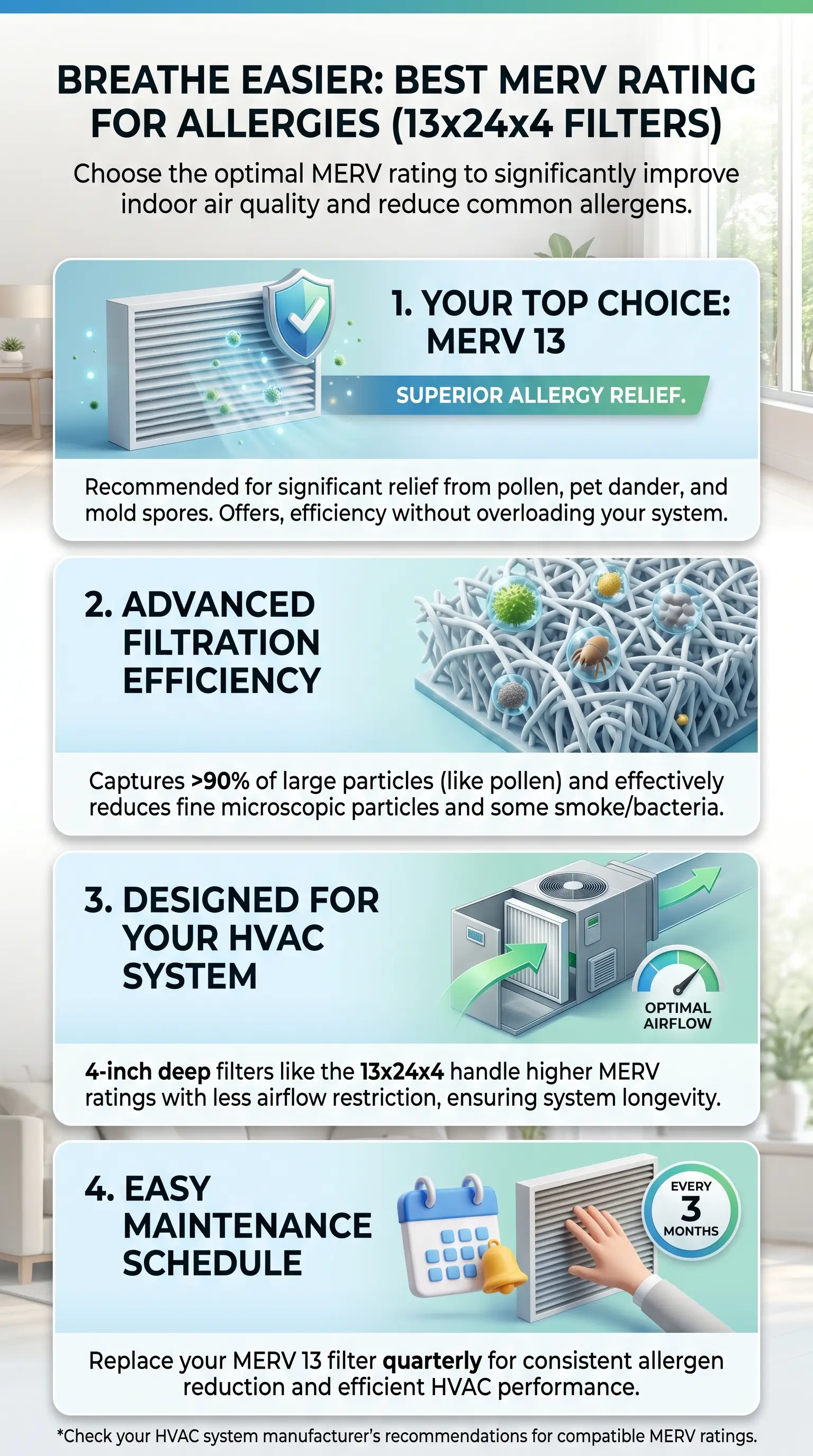
Most allergy symptoms get worse indoors, not better. The filter inside your return vent is usually the reason. A 13x24x4 slot is a 4-inch-deep filter bay, which means your HVAC handles a higher MERV rating without the airflow penalty a thinner filter would pay.
MERV, short for Minimum Efficiency Reporting Value, is the standard measure of how small a particle your air filter actually traps. For allergy households, it's the single most important number on the box. The right answer for a 13x24x4 slot depends on how hard the allergies hit and which particles you're fighting, and it isn't always the highest number available.
TL;DR Quick Answers
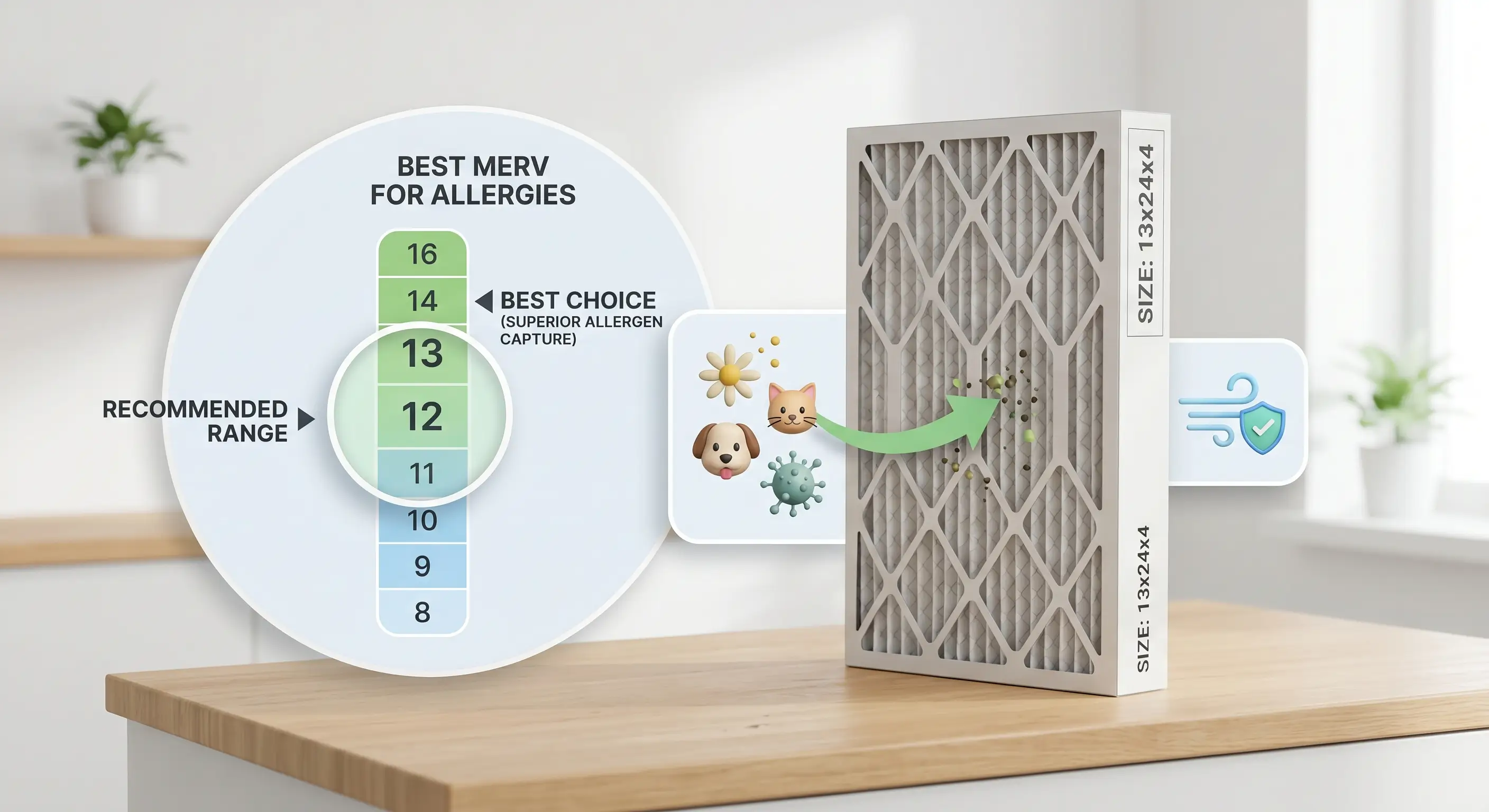
Best MERV for most allergy households in a 13x24x4 slot: MERV 11 (~95% particle capture).
Best MERV for severe allergies, asthma, or multi-pet homes: MERV 13 (~98% capture).
Why the 4-inch depth matters: more surface area means higher MERV with less airflow drag.
Replacement cadence for allergy homes: every 6 weeks.
Pair it with a whole-home UV light to handle biological contaminants.
Top Takeaways
MERV 11 is the everyday sweet spot for allergy households in a 13x24x4 size. It balances capture rate and airflow without compromising either.
MERV 13 is the stronger call for severe allergies, asthma, multiple pets, or Florida's year-round pollen pressure.
A 4-inch deep pleat handles high MERV ratings with far less airflow resistance than a 1-inch filter at the same rating. The pressure drop chart tells the full story.
Replace your filter every 6 weeks if someone in the house has allergies. A clogged high-MERV filter underperforms a clean lower-MERV one every time.
Pair a high-MERV filter with UV light for the strongest indoor air protection, especially in humid climates.
What MERV Really Measures
MERV rates filters from 1 to 20 based on how efficiently they capture particles between 0.3 and 10 microns. The higher the number, the finer the particles the filter pulls from your air. Pollen runs 10 to 100 microns. Mold spores, 3 to 40. Pet dander, 0.5 to 10. Lower-MERV filters miss the exact particles that set off allergy symptoms. If you're new to filters altogether, this filter basics guide is a solid primer before you shop.
One quick note on sizing. The "13x24x4" printed on the frame is a nominal size. Actual dimensions run slightly smaller. If you're unsure what you're working with, this walkthrough on how to measure actual size covers it before you order.
MERV Options for a 13x24x4 Filter
Filterbuy builds this size in three residential ratings. Here's what each one actually captures.
MERV 8 (Standard). Captures roughly 90% of airborne particles. Fine for general dust, lint, and large pollen. Enough for a healthy household. Light for allergy sufferers.
MERV 11 (Superior). Captures about 95% of airborne particles, including finer pollen, pet dander, and most mold spores. This is the rating we recommend for everyday allergy households.
MERV 13 (Optimal). Captures roughly 98% of airborne particles, including smoke, bacteria, and the smallest dander fragments. Hospital-grade filtration. The right call when allergies are severe or someone in the house has asthma. See a stocked hospital-grade option in the 13x24x4 size to know what a MERV 13 pleated filter looks like on the shelf.
Why 4-Inch Depth Changes the Conversation
For most allergy households in a 13x24x4 size, MERV 11 is the sweet spot. It captures nearly every allergen-carrying particle most people react to, without asking your system to work overtime. Step up to MERV 13 when symptoms are severe, when asthma is in the picture, when you have multiple pets, or when you live somewhere like Florida with year-round pollen and humidity pressure. Hold a 4-inch pleat next to a thinner 1-inch version in the same 13x24 footprint and you'll see why depth matters. Same face. Roughly one-quarter the filtering surface.
Most homeowners miss the part that actually matters. The same MERV rating performs very differently in a 1-inch filter versus a 4-inch filter. Plenty of systems use a basic panel filter in common sizes like 16x20x1, or different filter sizes like 20x25x1, and those slots can't push MERV 13 without airflow complaints. Your 13x24x4 slot is engineered for depth. In your size, you can go higher on the MERV scale without paying for it at the thermostat.
Replace It More Often Than You Think
A clogged high-MERV filter performs worse than a clean lower-MERV one. If someone in your home has asthma or allergies, replace your 13x24x4 filter every 6 weeks. Pet households, every 2 months. A standard family, every 3 months. Staying ahead of a schedule beats catching up to one. These replacement basics cover the what-and-when. And these replacement schedule tips help if you're rebuilding your maintenance routine from scratch.
After more than a decade of building filters for allergy households, we've learned depth usually matters more than MERV rating. Swap a dense 1-inch MERV 13 for a 4-inch MERV 11 in the same system, and symptoms often drop the same week.
7 Essential Resources
Every source below comes from a government agency, non-profit health authority, or recognized medical institution, so you can verify anything in this guide and go deeper on your own.
U.S. Environmental Protection Agency. Guide to Air Cleaners in the Home. Official EPA guidance on HVAC filters, MERV ratings, and selecting the right filtration for your home. epa.gov/indoor-air-quality-iaq/guide-air-cleaners-home
Centers for Disease Control and Prevention. Diagnosed Allergic Conditions in Adults: United States, 2021 (NCHS Data Brief No. 460). National data on seasonal allergy, eczema, and food allergy prevalence. cdc.gov/nchs/products/databriefs/db460.htm
Asthma and Allergy Foundation of America. Control Indoor Allergens to Improve Indoor Air Quality. Practical, patient-facing guidance on reducing dust mites, dander, pollen, and mold indoors. aafa.org/allergies/prevent-allergies/control-indoor-allergens/
American Lung Association. Air Cleaning: How Air Filters and HVAC Systems Work. ALA's consumer guide on MERV ratings, filter upgrades, and replacement cadence. lung.org/clean-air/indoor-air/protecting-from-air-pollution/air-cleaning
American Academy of Allergy, Asthma & Immunology. Managing Indoor Allergen Culprits. Expert-reviewed overview of the major indoor allergens and how to reduce exposure. aaaai.org/tools-for-the-public/conditions-library/allergies/managing-indoor-allergen
Mayo Clinic. Allergy-proof your home. Room-by-room medical guidance on reducing allergen triggers, including filtration and HVAC tips. mayoclinic.org/diseases-conditions/allergies/in-depth/allergy/art-20049365
ASHRAE. American Society of Heating, Refrigerating and Air-Conditioning Engineers. The engineering body that wrote ANSI/ASHRAE Standard 52.2, which defines the MERV rating system. ashrae.org
3 Statistics
Indoor air is often 2 to 5 times more polluted than outdoor air, and in some homes 100 times worse. Americans spend about 90% of their time indoors, which means the air moving through your HVAC is the air your allergies live in. (Source: U.S. EPA, Indoor Air Quality.) epa.gov/report-environment/indoor-air-quality
More than 100 million people in the United States live with some form of allergy every year, and climate change keeps pushing pollen seasons longer and more intense. That's a growing population who need their indoor air to do more, not less. (Source: Asthma and Allergy Foundation of America, Allergy Capitals Report.) aafa.org/asthma-allergy-research/allergy-capitals/
In 2021, 25.7% of U.S. adults, roughly 1 in 4, had a diagnosed seasonal allergy. Women were significantly more likely than men to be affected (29.9% vs. 21.1%). (Source: CDC, National Center for Health Statistics, Data Brief No. 460.) cdc.gov/nchs/products/databriefs/db460.htm
Final Thoughts and Opinion
A decade of building filters has taught us one thing about allergy households. If you have a 13x24x4 filter slot, you've already won the hardest battle. Your HVAC handles a serious filter by design. Don't waste that on a MERV 8 basic panel. Start at MERV 11 as a baseline. Step up to MERV 13 if symptoms are stubborn, if a family member has asthma, or if you live in a humid, pollen-heavy market like most of Florida.
Change it on schedule. The best filter in the world can't do its job if it's packed with last season's dust. If your home uses a different slot elsewhere in the house, alternate size filters like an 18x30x1 follow the same rules. Pick the right MERV. Change on cadence. Symptoms go down. A light assist from a few air-filtering houseplants won't replace a filter, but they make a nice supporting player.
Clean air is the most invisible form of family protection you can give your home. A MERV 11 or MERV 13 filter in a 13x24x4 slot is one of the most cost-effective moves you can make for it.
Frequently Asked Questions
Is MERV 13 too high for a home HVAC system?
Not in a 13x24x4 slot. Four-inch deep-pleated filters carry significantly more surface area than one-inch filters, which lets them handle MERV 13 without meaningfully restricting airflow. If your system accepts a 4-inch filter, the engineers built it with higher MERV in mind. If your HVAC is older or you're hearing strain at the blower, grab a quick HVAC repair estimate before you jump ratings. It's cheap insurance.
What's the difference between MERV 11 and MERV 13 for allergies?
MERV 11 captures about 95% of airborne particles, including most pollen, dust mite debris, and pet dander. MERV 13 steps that up to roughly 98% and reaches finer particles like smoke and bacteria-sized fragments. For everyday seasonal allergies, MERV 11 usually covers it. Severe allergies, asthma, or immunocompromised family members push you toward MERV 13.
How often should I change a 13x24x4 filter if I have allergies?
Every 6 weeks for allergy households. The extra cadence matters because a loaded filter loses efficiency and raises airflow resistance, which makes it harder for your system to circulate clean air. Pair filter changes with a professional system tune-up to catch slow-building problems before your next allergy season.
Will a higher MERV rating raise my energy bill?
Slightly, but less than you'd expect in a 4-inch deep pleat like the 13x24x4. The larger surface area spreads airflow across more pleats, which keeps pressure drop low. In one-inch filters, the energy cost of jumping to MERV 13 is more noticeable. In your size, it's usually negligible.
Where should I buy a 13x24x4 allergy filter?
Major retailers carry the size, and marketplace alternatives exist too. Verify the MERV rating, the actual dimensions, and the manufacturer before you add to cart. The cheapest listing on a third-party marketplace isn't always authentic.
Ready to Breathe Easier?
Your family's breathing is too important to leave to a basic MERV 8 panel. If you already have a 13x24x4 slot, your HVAC was built to handle more. Give it the right filter. Browse premium 13x24x4 air filters made in the USA, shipped in 24 hours, and backed by more than a decade of filter manufacturing experience. Start filtering smarter and take back your indoor air.
Learn more about HVAC Care from one of our HVAC solutions branches…
Filterbuy HVAC Solutions - Miami FL - Air Conditioning Service
1300 S Miami Ave Apt 4806 Miami FL 33130
(305) 306-5027
https://maps.app.goo.gl/Ci1vrL596LhvXKU79